

Curriculum
Our Curriculum Intent
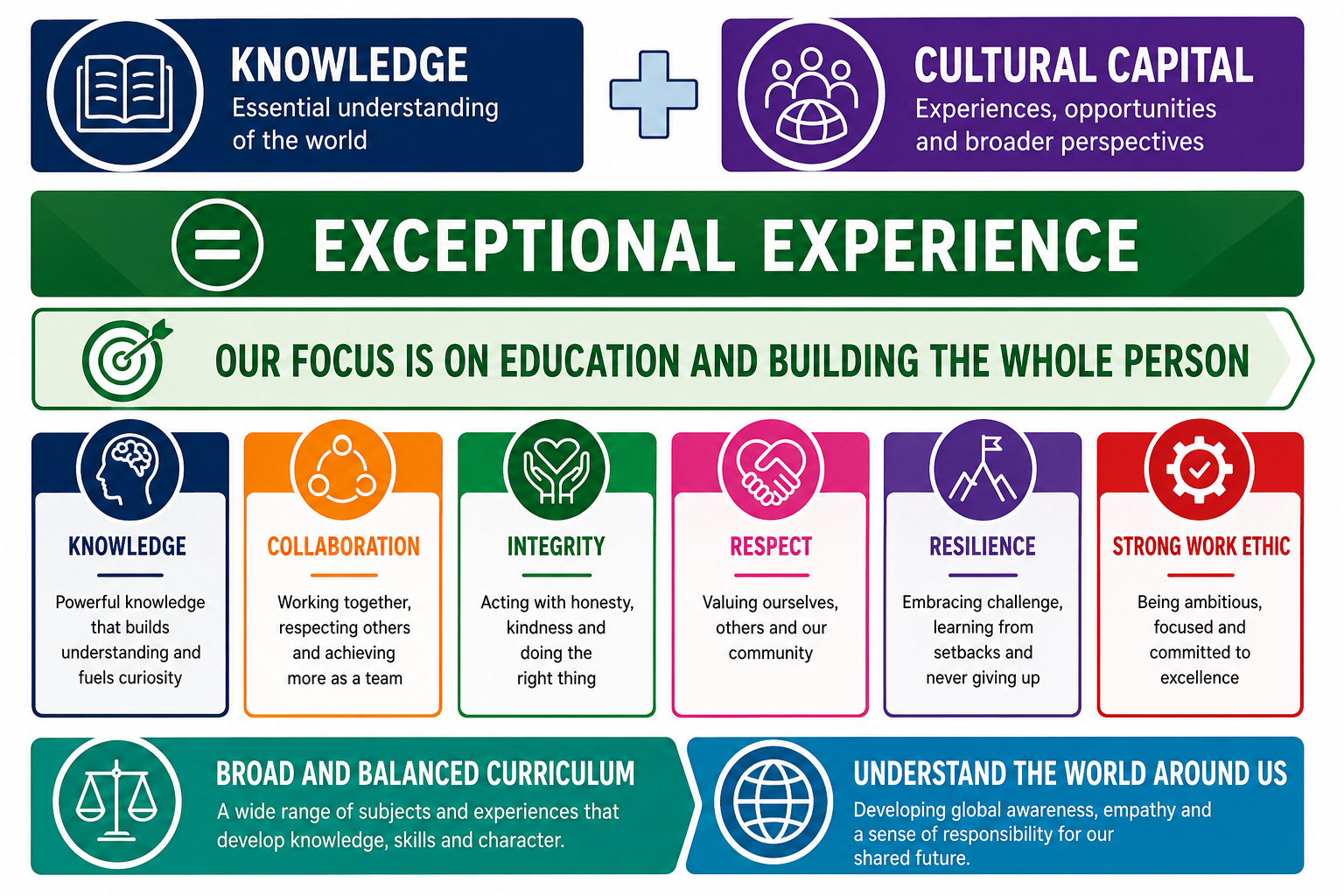
Our vision to create a 'community of excellence' is driven by the broad and balanced curriculum at New Line Learning Academy. We provide all students with a high-quality, aspirational education to prepare them academically, socially and personally for the opportunities, challenges and responsibilities of further or higher education, employment and adult life.
The Creative Curriculum
Creativity, at NLL, is not only about producing creative outcomes, but about thinking creatively, challenging our understanding of the world around us, and opening up exciting and meaningful pathways for the future.
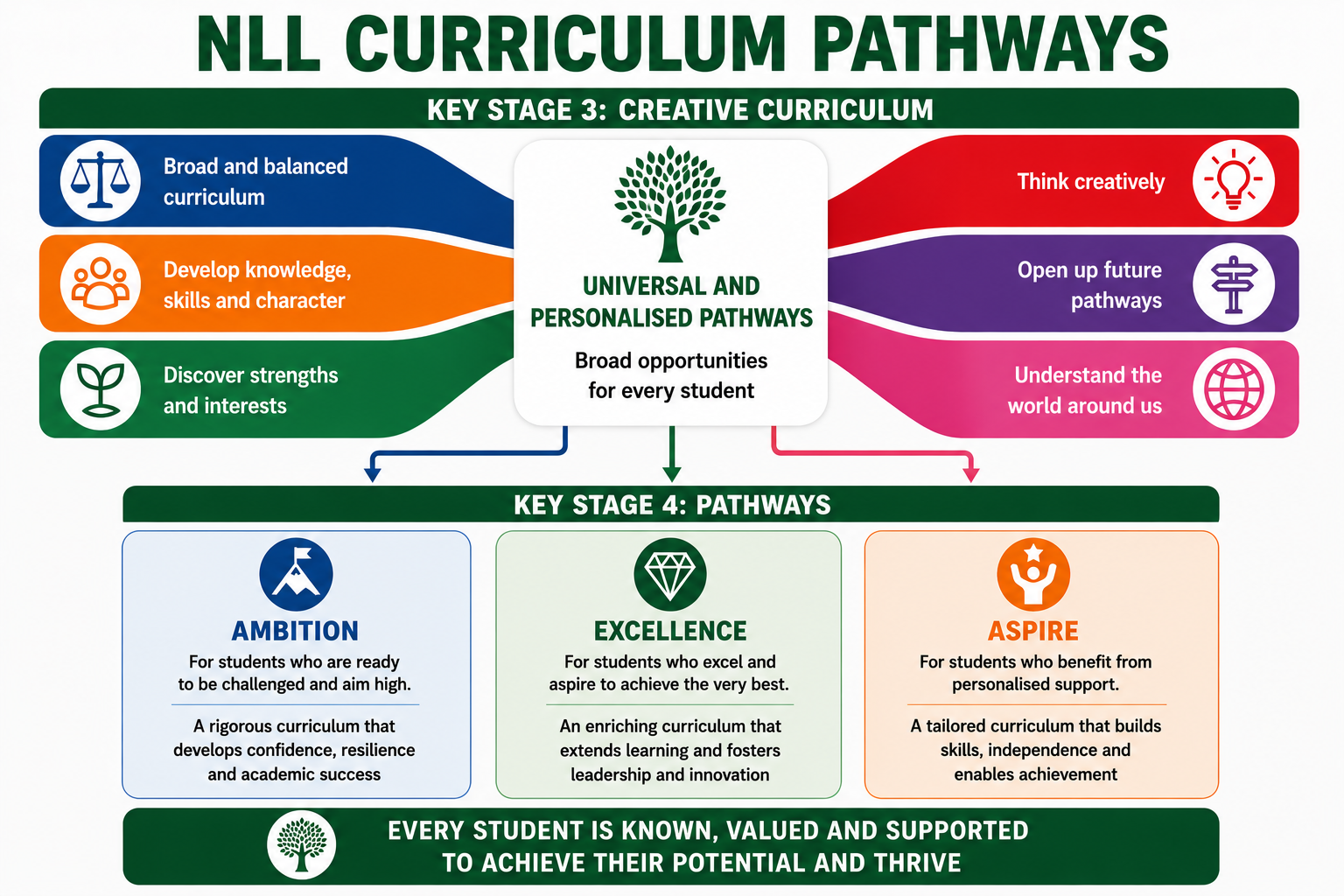
As an all-ability school, we are committed to ensuring that every student is supported, challenged, and inspired to succeed. At Key Stage 3, our students will experience a rich and broad curriculum across both core and creative subjects, going beyond the National Curriculum and including a wide range of art and design technologies, digital literacy, performing arts and sport. The curriculum at Key Stage 3 will be designed to enable targeted interventions to take place to support our students’ literacy, numeracy, wellbeing, and resilience.
At Key Stage 4, this commitment is reflected in the introduction of three carefully designed and inclusive curriculum pathways: Ambition, Excellence, and Aspire. These pathways are personalized to meet individual needs, continuing to provide targeted intervention and support where required, and ensure that all students follow ambitious and appropriate routes that reflect their strengths, interests, and future goals. This approach allows us to have the highest expectations for all our students, while recognizing that children thrive in different ways and at different paces.
Our curriculum is developmental. This means it will:
- Reinforce prior learning and increase in cognitive complexity.
- Widen out as the student moves through the school, revisiting concepts in greater depth.
Our curriculum considers the order in which concepts are taught. This means it will:
- Take into account the order of subject content.
- Consider where in students development content will be taught.
- Reinforces key concepts over time.
Our curriculum takes into account short-, medium- and long-term planning. This means there will be:
- A curriculum roadmap for students learning journey from year 7 to year 11.
- Yearly and termly planning of subject content.
- Lessons that are planned effectively to deliver the curriculum.
High Impact Teaching and Learning
Our teachers are subject experts who persistently advance their knowledge. They debate its content and pedagogy to ensure that our students are taught the very best, and in doing so, they aim for our students to love their subject. Our teachers make links with other subjects to draw on students’ prior knowledge and enable them to understand new content.
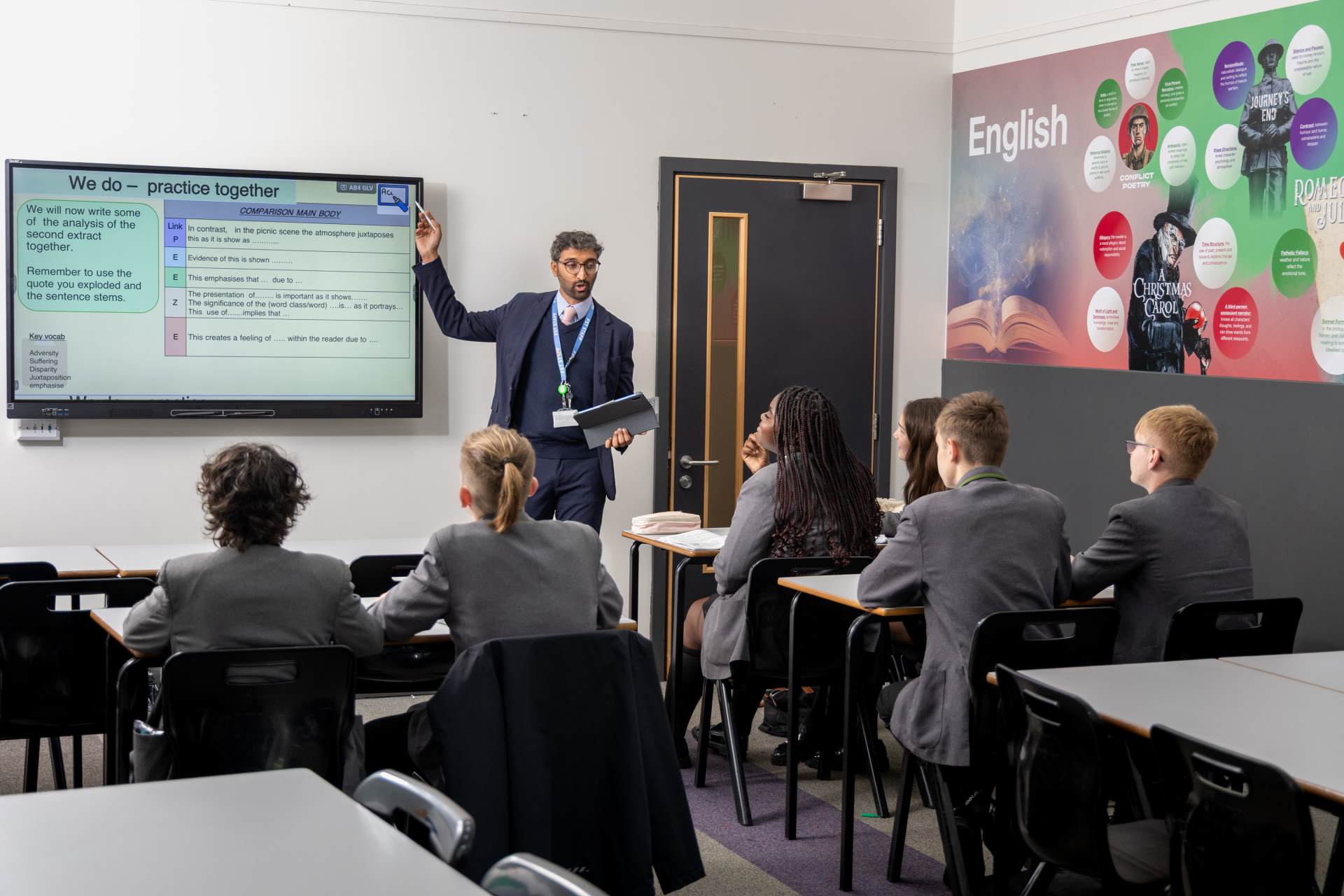
Our curriculum is implemented through our High Impact Teaching Lesson Structure. Rosenshine’s ‘Principles of Instruction’ outline an effective lesson structure based on research into:
- cognitive science
- classroom practices
- studies of highly effective teachers.
The principles are designed to support learning by promoting clarity, active engagement, consistent review and a high level of success through deliberate rehearsal.
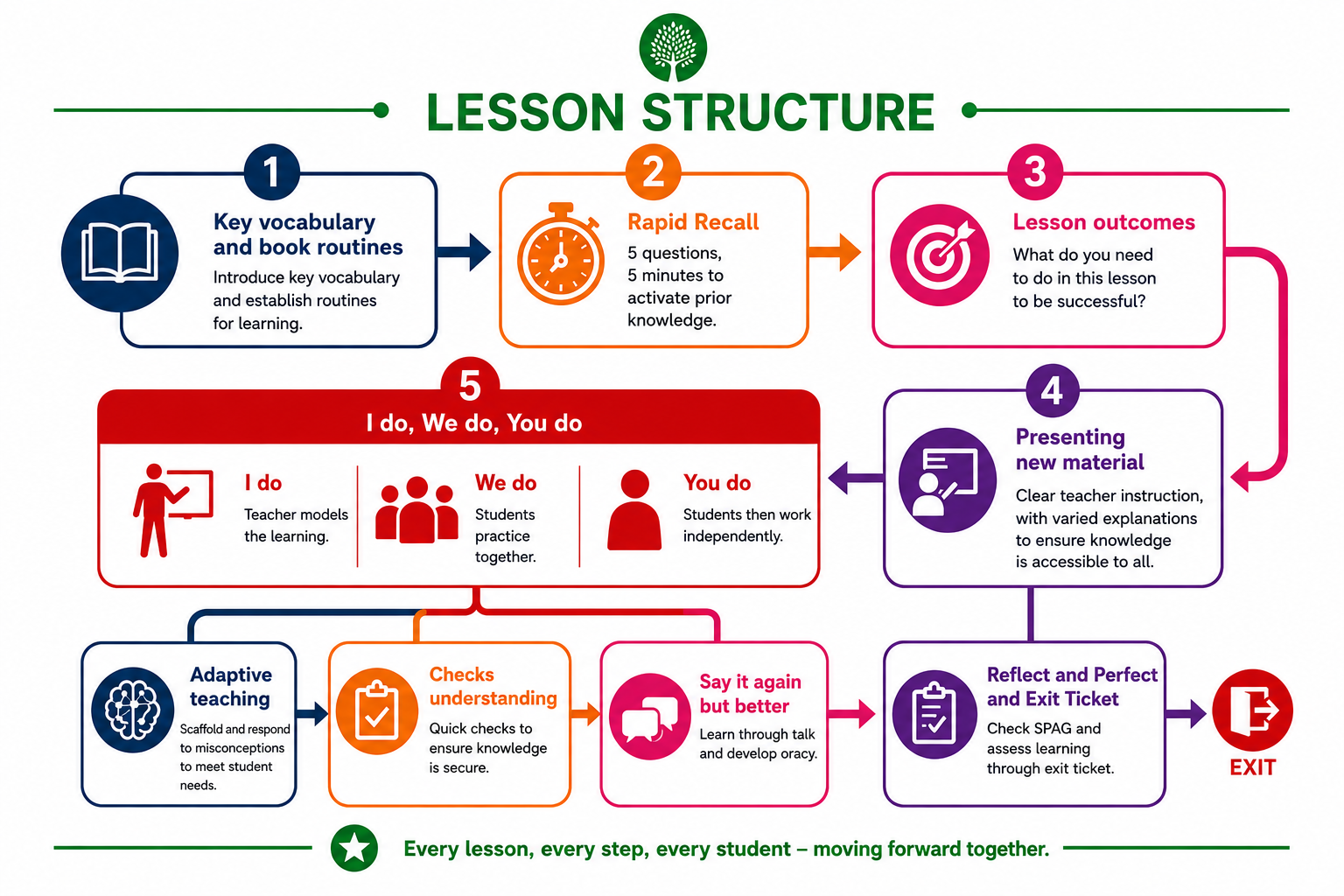
The HIT Model ensures that lessons consistently include the following routines for learning:
- Consistent entry routines
- Slides that minimize cognitive load
- Direct Vocabulary Instruction (DVI) to introduce key word for the lesson
- Rapid Recall activity of 5 questions to support recall of prior knowledge
- Learning Outcomes, ‘the why’ and success criteria are introduced
- Direct instruction for new input
- I do – modelling
- We do – scaffolding
- You do – independent practice
- Developing oracy – ‘say it again but better’ for high expectations of verbal contributions
- Frequent checking for understanding and addressing misconceptions
- Adaptive teaching to meet individual needs throughout the lesson
- Reflect and perfect routines for written work
- Feedforward exit tickets to check for understanding
- Consistent exit routines.
Our mantra is ‘Every Lesson Counts’. We expect our students to:
- Always meet expectations for good behaviour for learning, respecting the rights of others to learn.
- Take responsibility for their own learning and support the learning of others, including communicating with teachers and support staff about their learning progress and ask for help when needed.
- Attend all lessons on time and be ready to learn, with any necessary equipment for the lesson.
- Show respectful listening when others are speaking
- Be curious, ambitious, engaged and confident learners.
- Know their targets and how to improve.
- Put maximum effort and focus into their work.
- Complete home learning activities as required.
Curriculum hours
Key Stage 3 Pathway Lesson hours per fortnight.
| Subject | Year 7 | Year 8 | Year 9 |
| Maths | 6 | 6 | 6 |
| English | 8 | 8 | 8 |
| Science | 6 | 6 | 6 |
| Geography | 3 | 3 | 3 |
| History | 3 | 3 | 3 |
| World Views | 2 | 2 | 2 |
| Spanish | 2 | 2 | 2 |
| DT - RM | 2 | 2 | 2 |
| DT - Textiles | 2 | 2 | 2 |
| DT - Food/Graphics carousel | 2 | 2 | 2 |
| Art | 2 | 2 | 2 |
| Digital Literacy* | 2 | 2 | 2 |
| Drama* | 2 | 2 | 2 |
| Dance* | 2 | 2 | 2 |
| Music | 2 | 2 | 2 |
| PE | 2 | 2 | 2 |
| Pathways | 2 | 2 | 2 |
| Total | 50 | 50 | 50 |
Key Stage 3 Personalised Pathway Lesson hours per fortnight.
| Subject | Year 7 | Year 8 | Year 9 |
| Maths | 6 | 6 | 6 |
| English | 8 | 8 | 8 |
| Science | 6 | 6 | 6 |
| Humanities | 4 | 4 | 4 |
| World Views* | 2 | 2 | 2 |
| Forest School* | 2 | 2 | 2 |
| Literacy* | 2 | 2 | 2 |
| DT - RM | 2 | 2 | 2 |
| DT - Textiles | 2 | 2 | 2 |
| DT - Food/Graphics carousel | 2 | 2 | 2 |
| Art | 2 | 2 | 2 |
| Digital Literacy* | 2 | 2 | 2 |
| Drama* | 2 | 2 | 2 |
| Dance* | 2 | 2 | 2 |
| Music | 2 | 2 | 2 |
| PE | 2 | 2 | 2 |
| Pathways | 2 | 2 | 2 |
| Total | 50 | 50 | 50 |
Year 10 Lesson hours per fortnight.
| Subject | Ambition / + | Excellence | Aspire |
|---|---|---|---|
| Maths | 8 | 10 | 10 |
| English | 8 | 10 | 10 |
| Science | 8 | 9 | — |
| Biology | — | — | 6 |
| RE | 2 | 2 | 2 |
| Humanities | 5 | 5 | — |
| Outdoor Learning | — | — | 6 |
| Option 1 / or MFL | 5 | 5 | — |
| Option 1 | — | — | 5 |
| Option 2 | 5 | 5 | — |
| Option 3 | 5 | — | — |
| AQA Awards | — | — | 5 |
| Functional Skills | — | — | 2 |
| Core PE | 2 | 2 | 2 |
| Pathways | 2 | 2 | 2 |
| Total | 50 | 50 | 50 |
| Subject | Year 11 |
| Maths | 8 |
| English | 8 |
| Science | 8 |
| RE | 2 |
| Humanities | 5 |
| Option 1 / or MFL | 5 |
| Option 2 | 5 |
| Option 3 | 5 |
| Core PE | 2 |
| Pathways | 2 |
| PSHE/RE - tutor time | — |
| Total | 50 |
Relationships, Health and Sex Education
At New Line Learning Academy, PSHE is central to preparing pupils for the opportunities, responsibilities, and experiences of life, supporting their physical and emotional well-being, and promoting their personal development.
The aims of PSHE at New Line Learning Academy are:
- To provide pupils with the knowledge, understanding, attitudes, and practical skills to live healthy, safe, productive, and fulfilled lives.
- To foster personal development and well-being, allowing students to reflect on and clarify their values and attitudes.
- To encourage students to make responsible decisions regarding their well-being, relationships, and careers.
- To prepare students for their roles as active, responsible citizens in a diverse and changing world.
The PSHE curriculum at New Line Learning Academy is divided into three core themes:
- Health and Wellbeing: Including topics such as physical health, mental well-being, puberty, healthy lifestyles, drugs, and alcohol education.
- Relationships: Covering respect, bullying, friendships, family, consent, and online safety.
- Living in the Wider World: Encompassing financial education, employability skills, citizenship, and environmental awareness.
PSHE at New Line Learning also incorporates the Fundamental British Values of Democracy, Rule of Law, Tolerance, Mutual Respect and Individual Liberty. An understanding of the different religious beliefs and values is covered as part of our PSHEE curriculum.
As part of our New Line Learning Academy Next Steps programme, we empower students to explore diverse career pathways, equipping them with the skills, knowledge, and confidence to thrive in a rapidly changing world. Through personalised guidance, real-world experiences, and a strong focus on personal growth, we help each student discover their passion and unlock their potential, preparing them for success in higher education and the workplace.
RE & World Views
At New Line Learning Academy, our Religion and Worldviews curriculum encourages students to ask life's biggest questions, explore diverse beliefs and perspectives, and develop the knowledge and skills to become thoughtful, respectful, and informed members of society. Through enquiry-based learning, students investigate religion, philosophy, ethics, and human rights, developing the confidence to analyse evidence, evaluate different viewpoints, and justify their own conclusions.
Across Key Stage 3, students explore how religion and worldviews shape individuals, communities, and societies. Beginning with identity, belonging, and diversity in Year 7, students’ progress to exploring ethics, humanity, and social responsibility in Year 8 before tackling philosophical questions, human rights, and contemporary ethical issues in Year 9. Throughout the curriculum, students encounter a wide range of religious and non-religious worldviews, developing an understanding of Christianity, Islam, Buddhism, Sikhism, Hinduism, Humanism, and other belief systems while making meaningful connections to life in modern Britain.
The curriculum is carefully sequenced to support the Kent Agreed Syllabus and is enriched through links to Citizenship and the RSHE curriculum, allowing students to explore themes such as diversity, equality, democracy, human rights, justice, community responsibility, respectful relationships, and active citizenship. Students are encouraged to think critically, challenge stereotypes, appreciate different perspectives, and engage confidently with the complex moral and philosophical questions that shape today's world.
At Key Stage 4, students study the AQA GCSE Religious Studies Short Course, developing a deeper understanding of both Christianity and Islam alongside contemporary ethical issues. Students explore topics including Families and Relationships, Religion, Peace and Conflict, and the beliefs, practices, and influence of Christianity and Islam. They develop sophisticated analytical and evaluative skills, considering how religious beliefs influence responses to modern moral issues while preparing for further study and life in an increasingly diverse society.
Our Religion and Worldviews curriculum aims to inspire curiosity, promote empathy, and equip every student with the knowledge, understanding, and critical thinking skills needed to engage thoughtfully with the world around them. Whether discussing philosophy, debating ethical dilemmas, exploring global issues, or understanding the beliefs of others, students leave New Line Learning Academy prepared to contribute positively to modern Britain and the wider world.
If you require further information on our curriculum please contact Mrs Fernandez, Deputy Headteacher at cfernandez@newlinelearning.com